
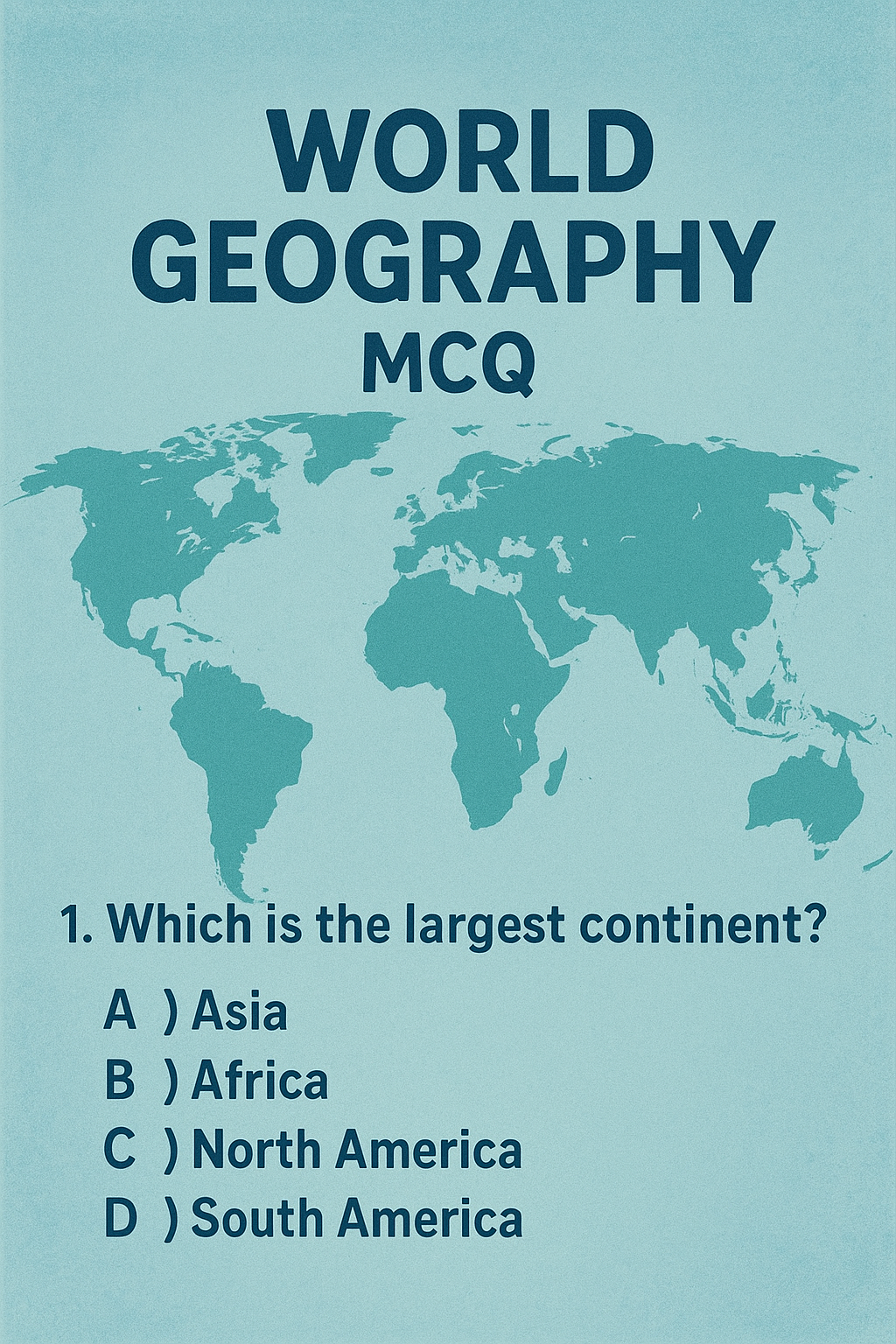
World Geography MCQs with Answers – Test Your Knowledge
Looking for a quick and effective way to revise world geography questions? This collection of World Geography MCQs brings together important topics often asked in exams, making it the perfect practice set for students, aspirants, and quiz enthusiasts.
- By commonly accepted length, which river is considered the world’s longest?
A) Amazon
B) Nile
C) Yangtze
D) Mississippi–MissouriShow Answer
Answer: B — The Nile is traditionally listed as longest at about 6,650 km, though some studies argue for the Amazon; “commonly accepted” favors the Nile.
- Which is Earth’s largest desert by total area?
A) Sahara
B) Arabian
C) Gobi
D) Antarctic DesertShow Answer
Answer: D — Antarctica is a cold desert with extremely low precipitation and is larger than the Sahara.
- Which lake is the deepest on the planet Earth ?
A) Tanganyika
B) Superior
C) Baikal
D) VostokShow Answer
Answer: C — Lake Baikal in Russia reaches about 1,642 m and also holds the most liquid freshwater by volume.
- Which mountain range is the longest on land?
A) Himalaya
B) Rockies
C) Andes
D) AlpsShow Answer
Answer: C — The Andes stretch roughly 7,000 km along South America’s western margin.
- What is the world’s largest island excluding continents?
A) New Guinea
B) Greenland
C) Borneo
D) MadagascarShow Answer
Answer: B — Greenland is about 2.16 million km², the largest non‑continental island.
- Which peninsula has the greatest land area globally?
A) Scandinavian
B) Iberian
C) Arabian
D) YucatánShow Answer
Answer: C — The Arabian Peninsula spans roughly 3.2 million km².
- Which plateau has the highest overall elevation?
A) Deccan
B) Anatolian
C) Tibetan
D) ColoradoShow Answer
Answer: C — The Tibetan Plateau averages over 4,000–4,500 m, known as the “Roof of the World.”
- Which river system forms the world’s largest delta?
A) Niger Delta
B) Okavango Delta
C) Sundarbans (GBM)
D) Lena DeltaShow Answer
Answer: C — The Ganges–Brahmaputra–Meghna system builds the vast Sundarbans delta along India–Bangladesh.
- Which is the world’s largest coral reef system?
A) Mesoamerican Reef
B) New Caledonian Barrier
C) Great Barrier Reef
D) Red Sea Coral ReefShow Answer
Answer: C — Australia’s Great Barrier Reef extends ~2,300 km off Queensland.
- Which ocean covers the greatest surface area?
A) Atlantic
B) Indian
C) Pacific
D) SouthernShow Answer
Answer: C — The Pacific spans about 165 million km², the largest ocean basin.
- The deepest point in Earth’s oceans lies in which trench?
A) Tonga Trench
B) Puerto Rico Trench
C) Mariana Trench
D) Philippine TrenchShow Answer
Answer: C — Challenger Deep in the Mariana Trench reaches nearly 11 km.
- Which country generally has the most active volcanoes?
A) Japan
B) Indonesia
C) USA
D) ItalyShow Answer
Answer: B — Indonesia sits astride multiple subduction zones in the Pacific “Ring of Fire.”
- Which freshwater lake has the largest surface area?
A) Lake Superior
B) Lake Michigan
C) Lake Victoria
D) Lake HuronShow Answer
Answer: A — Lake Superior covers ~82,100 km², the largest freshwater lake by area.
- Which river has the greatest average discharge?
A) Amazon
B) Congo
C) Ganga
D) YangtzeShow Answer
Answer: A — The Amazon discharges ~209,000 m³/s to the Atlantic.
- Name the warm current along North America’s east coast.
A) Kuroshio
B) Gulf Stream
C) Canary
D) BenguelaShow Answer
Answer: B — The Gulf Stream transports warm water northeastward from the Gulf of Mexico.
- Which cold current flows along southwestern Africa?
A) Labrador
B) Peru
C) Benguela
D) CanaryShow Answer
Answer: C — The Benguela Current brings cool, nutrient‑rich waters up Africa’s southwest coast.
- Which strait links the Mediterranean Sea to the Atlantic Ocean?
A) Bosporus
B) Malacca
C) Gibraltar
D) DoverShow Answer
Answer: C — The Strait of Gibraltar separates Europe and Africa at the Med’s outlet.
- Which canal joins the Mediterranean Sea with the Red Sea?
A) Panama Canal
B) Suez Canal
C) Kiel Canal
D) Corinth CanalShow Answer
Answer: B — The Suez Canal provides a direct Europe–Asia sea route without rounding Africa.
- Which desert is chiefly arid due to the Andes’ rain shadow?
A) Namib
B) Atacama
C) Kalahari
D) SonoranShow Answer
Answer: B — Moisture is blocked by the Andes, making the Atacama one of the driest places on Earth.
- Which volcano is the highest active volcano on Earth?
A) Mauna Loa
B) Etna
C) Ojos del Salado
D) CotopaxiShow Answer
Answer: C — Ojos del Salado (~6,893 m) on the Argentina–Chile border shows fumarolic activity.
- Which continent has the highest mean elevation?
A) Asia
B) Antarctica
C) South America
D) AfricaShow Answer
Answer: B — Antarctica’s ice‑capped plateau averages ~2,500 m above sea level.
- What is the lowest exposed point on Earth’s land surface (shoreline)?
A) Turpan Depression
B) Death Valley
C) Dead Sea shore
D) Lake Assal shoreShow Answer
Answer: C — The Dead Sea shoreline is around 430 m below sea level.
- Which is the largest enclosed inland saltwater body?
A) Dead Sea
B) Aral Sea
C) Caspian Sea
D) Great Salt LakeShow Answer
Answer: C — The Caspian Sea is a vast endorheic basin with saline water.
- Which mountain chain is commonly treated as Europe–Asia’s divide?
A) Alps
B) Urals
C) Caucasus only
D) ApenninesShow Answer
Answer: B — The Ural Mountains are the conventional intercontinental boundary in the east.
- Which waterfall has the greatest vertical drop?
A) Niagara
B) Victoria
C) Iguazu
D) Angel FallsShow Answer
Answer: D — Venezuela’s Angel Falls plunges ~979 m.
- Which bay is the largest by area worldwide?
Show Answer
Answer: B — The Bay of Bengal is larger than Hudson Bay when defined as a bay.
- Which gulf is the largest by area?
A) Gulf of Mexico
B) Gulf of Guinea
C) Persian Gulf
D) Gulf of AdenShow Answer
Answer: A — The Gulf of Mexico spans roughly 1.6 million km².
- Which river is the longest in Europe?
A) Danube
B) Rhine
C) Volga
D) DnieperShow Answer
Answer: C — The Volga runs about 3,530 km to the Caspian Sea.
- Which is the highest navigable lake in the world?
A) Poopó
B) Van
C) Titicaca
D) TanaShow Answer
Answer: C — Lake Titicaca sits around 3,812 m on the Peru–Bolivia plateau.
- Which summit is the highest outside Asia?
A) Denali
B) Aconcagua
C) Elbrus
D) KilimanjaroShow Answer
Answer: B — Aconcagua (6,961 m) in the Andes is the tallest outside Asia.
- Which European river passes through the most countries?
A) Danube
B) Volga
C) Loire
D) PoShow Answer
Answer: A — The Danube flows through or borders around ten countries.
- Which is the largest hot desert on Earth?
A) Gobi
B) Atacama
C) Sahara
D) Great VictoriaShow Answer
Answer: C — The Sahara spans ~9.2 million km² across North Africa.
- The Aral Sea lies mainly between which two nations?
A) Kazakhstan and Uzbekistan
B) Russia and Ukraine
C) Iran and Iraq
D) Turkmenistan and IranShow Answer
Answer: A — The shrunken Aral basin straddles Kazakhstan (north) and Uzbekistan (south).
- Along which Australian state’s coast does the Great Barrier Reef extend?
A) Western Australia
B) Northern Territory
C) Queensland
D) New South WalesShow Answer
Answer: C — It parallels Queensland’s coast in the Coral Sea.
- Which cold current runs along South America’s west coast?
A) Agulhas
B) Humboldt/Peru
C) Benguela
D) CanaryShow Answer
Answer: B — The Humboldt (Peru) Current cools the Pacific margin of Peru–Chile.
- The Gulf of Guinea, borders which continent?
A) South America
B) North America
C) Africa
D) EuropeShow Answer
Answer: C — It indents West Africa between about Ghana and Gabon.
- The Great Rift Valley is chiefly associated with which plate setting?
A) Convergent boundaries
B) Transform margins
C) Divergent movement
D) Hotspot arcsShow Answer
Answer: C — East Africa’s rift system is a continental divergent boundary.
- The Bosporus links which two seas?
A) Black Sea and Sea of Marmara
B) Red Sea and Arabian Sea
C) Baltic Sea and North Sea
D) Mediterranean and AtlanticShow Answer
Answer: A — The Bosporus and Dardanelles connect the Black Sea to the Mediterranean via the Marmara.
- The Great Lakes empty into the Atlantic via which river?
A) Mississippi
B) Mackenzie
C) St. Lawrence
D) ColoradoShow Answer
Answer: C — The St. Lawrence River–Seaway system drains the lakes to the Atlantic.
- What primarily defines the Sargasso Sea’s boundaries?
A) Landmasses
B) Ocean currents
C) Tectonic ridges
D) Coral reefsShow Answer
Answer: B — It’s bounded by the North Atlantic gyre’s circulating currents, not land.
- The “Pamir Knot” denotes a meeting of ranges in which region?
A) Southeast Asia
B) Central Asia
C) East Africa
D) Eastern EuropeShow Answer
Answer: B — The Pamirs lie in Central Asia, where major ranges converge.
- Extensive loess deposits are characteristic of which country’s plateau?
A) China
B) Brazil
C) Egypt
D) SpainShow Answer
Answer: A — China’s Loess Plateau is built of wind‑blown silt, deeply eroded into gullies.
- The Sahel is a semi‑arid transition zone located where?
A) South of the Sahara
B) North of the Kalahari
C) East of the Gobi
D) West of the AtacamaShow Answer
Answer: A — It spans across Africa just south of the Sahara from Senegal to Sudan.
- How are katabatic winds best defined?
A) Moist sea breezes
B) Downslope, gravity‑driven cold winds
C) Monsoonal reversals
D) Tropical easterliesShow Answer
Answer: B — Cold, dense air flows downhill under gravity, common in polar and mountainous areas.
- El Niño features unusual warming of sea surface temperatures in which region?
A) North Atlantic
B) Eastern equatorial Pacific
C) Southern Ocean
D) Arabian SeaShow Answer
Answer: B — SST anomalies in the eastern–central equatorial Pacific alter global circulation.
- Deep‑focus earthquakes (about 300–700 km) are chiefly associated with which setting?
A) Mid‑ocean ridges
B) Transform faults
C) Subduction zones
D) HotspotsShow Answer
Answer: C — They occur along subducting slabs descending into the mantle (Wadati–Benioff zones).
- Atolls primarily form due to which process?
A) River deposition
B) Wind erosion
C) Coral growth around subsiding volcanic islands
D) Glacial scouringShow Answer
Answer: C — Corals keep pace with slow subsidence, leaving ring‑shaped reefs enclosing lagoons.
- The International Date Line approximately follows which meridian, with deviations?
A) 0°
B) 90°E
C) 90°W
D) 180°Show Answer
Answer: D — It largely tracks 180° longitude but bends around islands to align with local time zones.
- Which strait separates Asia from North America?
A) Bering Strait
B) Davis Strait
C) Torres Strait
D) Sunda StraitShow Answer
Answer: A — The Bering Strait separates Russia (Chukotka) and Alaska.
- Which river drains the largest basin on Earth?
A) Yangtze
B) Nile
C) Amazon
D) Mississippi–MissouriShow Answer
Answer: C — The Amazon Basin covers about 7 million km², the world’s largest drainage area.
Practicing these World Geography MCQs regularly ensures that you stay confident and exam-ready. From the longest rivers to the largest deserts, mastering world geography quiz questions will give you an extra edge in competitive exams and quizzes. For more interesting practice, don’t forget to check out our other MCQ collections too.
50 important Architectural Monuments of India With images
The 8 Wonders of the World: Epic History & Iconic Monuments
100 Geography MCQs – Important Questions for Competitive Exams
Top 100 Assam Geography MCQs for ADRE & Other Exams (2025)
Tropic of Cancer | 50 Important MCQs with Answers
50 Important MCQs on Assam Rivers – Brahmaputra, Barak, Tributaries, and River Projects – PART TWO
50 Im
portant Poona Pact MCQs | Poona Pact History
The Poona Pact 1932 | Historical Significance, Key Provisions, and Impact on Dalit Rights