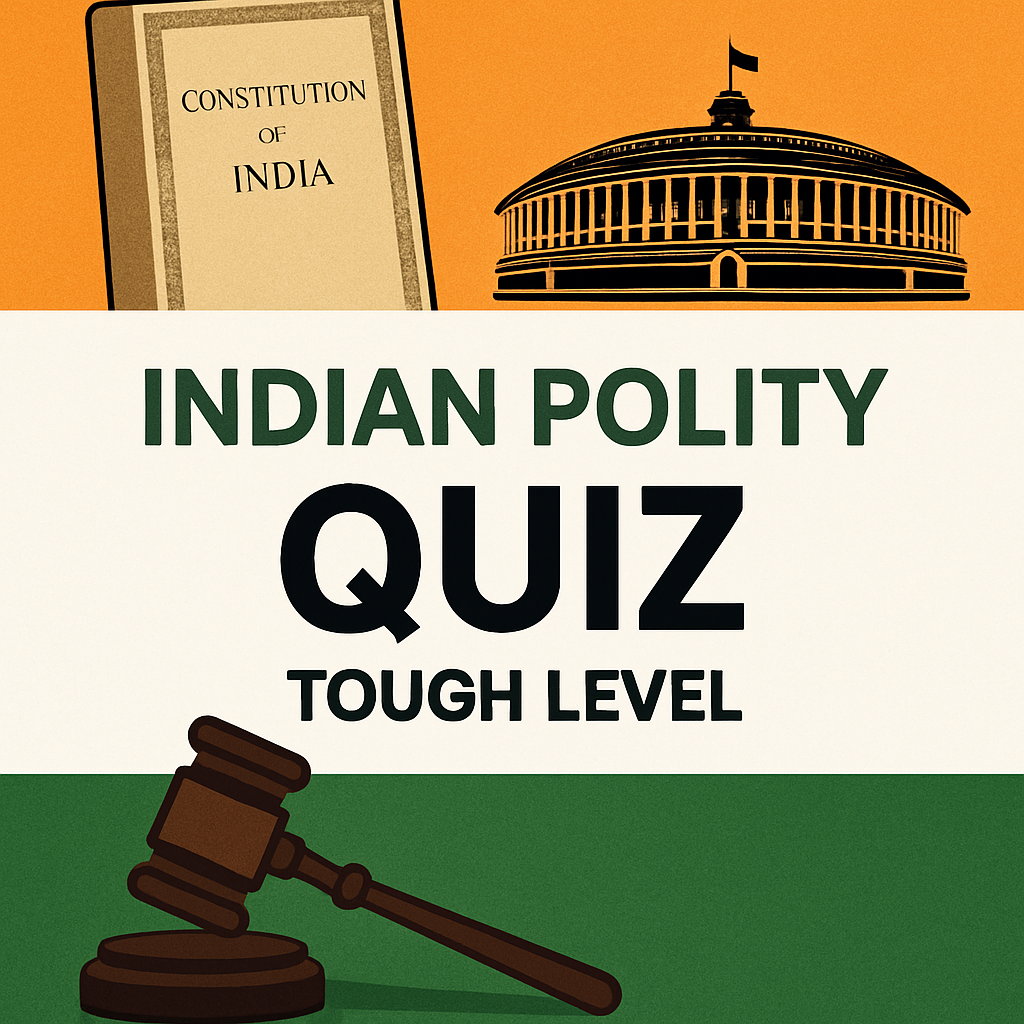
Sharpen Indian polity with a tough-level quiz built for UPSC, SSC, NDA, and police exams, covering Fundamental Rights, DPSP, Parliament, Judiciary, federalism, and constitutional bodies for fast exam-style revision. Designed to test depth, accuracy, and speed—ideal for last-mile preparation and quick self-assessment.
Indian Polity Quiz for UPSC, SSC, NDA & Police Exams
- Under Article 131, the Supreme Court's original jurisdiction extends to disputes between:
- Union and one or more States where a question of law or fact exists
- Union and citizens regarding Fundamental Rights
- Two or more citizens from different States
- State and local bodies regarding taxation
Show Answer
Correct answer: A
Article 131 confers exclusive original jurisdiction over disputes between the Union and States or among States involving a question (of law or fact) on which the existence or extent of a legal right depends. - Which constitutional changes require ratification by not less than one-half of the States under Article 368?
- Any Amendment affecting Part III only
- Matters like election of the President, extent of the Supreme Court's powers, and distribution of legislative powers
- Any Amendment introducing a new Directive Principle
- Any Amendment altering Fundamental Duties
Show Answer
Correct answer: B
Amendments affecting federal features—President's election, Union–State legislative lists, Supreme Court/High Court jurisdiction—need State ratification. - Who has the final authority to decide whether a Bill is a Money Bill in the Parliament?
- Chairman of Rajya Sabha
- Speaker of Lok Sabha
- President of India
- Finance Minister
Show Answer
Correct answer: B
Article 110(3): The Speaker's decision on whether a Bill is a Money Bill is final. - A joint sitting of both Houses can be summoned to resolve a deadlock for all of the following EXCEPT:
- Ordinary legislation
- Financial Bill (non-Money)
- Constitution Amendment Bill
- A Bill returned by the President under Article 111
Show Answer
Correct answer: C
Article 368 amendments cannot be decided by joint sitting; only ordinary bills under Article 108. - Which statement on Ordinances (Article 123) is correct?
- They remain valid for one year from promulgation regardless of Parliament's sessions
- They must be laid before both Houses and cease six weeks after reassembly unless approved
- They can amend the Constitution
- They cannot be withdrawn by the President once issued
Show Answer
Correct answer: B
An ordinance lapses six weeks after Parliament reassembles unless passed; it cannot amend the Constitution. - Which is NOT correct about parliamentary privileges in India?
- They include freedom of speech within the House
- They are fully codified in the Constitution
- They extend to parliamentary committees
- Breach may constitute contempt of the House
Show Answer
Correct answer: B
Privileges are partly defined; much is uncodified and based on rules, statutes, and precedents. - Under the Tenth Schedule (anti-defection), which is true after the 91st Constitutional Amendment?
- Split by one-third exempts members from disqualification
- Merger requires at least two-thirds of members of a party
- Presiding officer's decision is not subject to judicial review
- Nominated members are immediately subject to the Schedule upon nomination
Show Answer
Correct answer: B
The split exception was deleted; merger requires two-thirds. Decisions are reviewable; nominated members become subject after 6 months. - Finance Commission (Article 280) recommendations are:
- Binding on Union and States
- Advisory; accepted generally but not legally binding
- Binding if endorsed by the President
- Binding only on States
Show Answer
Correct answer: B
Finance Commission recommendations are advisory in nature; acceptance is executive/legislative. - Regarding the CAG of India, which is correct?
- Appointed by President and removed by a simple majority
- Remuneration is charged on the Consolidated Fund of India
- Does not audit government companies under the Companies Act
- Reports are laid only before the Rajya Sabha
Show Answer
Correct answer: B
CAG's salary is charged on CFI; removal is like a SC judge; CAG audits/governs audit of PSUs; reports are laid before Parliament. - Which veto is NOT available to the President in case of a Money Bill?
- Absolute veto
- Suspensive veto (return for reconsideration)
- Assent after recommendations
- Withholding assent
Show Answer
Correct answer: B
A Money Bill cannot be returned to the Lok Sabha; the President may assent or withhold. - The Basic Structure doctrine was established by which judgment?
- Golaknath v. State of Punjab (1967)
- Kesavananda Bharati v. State of Kerala (1973)
- Minerva Mills v. Union of India (1980)
- Waman Rao v. Union of India (1981)
Show Answer
Correct answer: B
Kesavananda Bharati (13-judge bench) propounded the basic structure limitation on amending power. - Regarding Ninth Schedule (Article 31B), which is correct post I.R. Coelho (2007)?
- All laws in Ninth Schedule are immune from judicial review
- Laws inserted after 24 April 1973 can be reviewed for violation of basic structure
- Only land reforms laws can be placed there
- SC struck down the entire Ninth Schedule
Show Answer
Correct answer: B
I.R. Coelho held post-1973 insertions are subject to basic-structure review. - Which Directive Principle was explicitly added to provide free legal aid?
- Article 39
- Article 39A
- Article 41
- Article 45
Show Answer
Correct answer: B
Article 39A (42nd Amendment) provides for equal justice and free legal aid. - Fundamental Duties (Article 51A) were added by the 42nd Amendment; which is true now?
- There are 10 Fundamental Duties
- They are enforceable by writ of mandamus as of right
- An additional duty (to provide education) was added by the 86th Amendment
- They override Fundamental Rights
Show Answer
Correct answer: C
The 86th Amendment added the duty to provide opportunities for education to children (making 11 duties). - State Election Commission is provided under:
- Article 243K
- Article 324
- Article 280
- Article 249
Show Answer
Correct answer: A
Article 243K deals with superintendence of elections to Panchayats (and 243ZA for Municipalities). - Which Schedule provides autonomous district councils in certain North-Eastern areas?
- Fifth Schedule
- Sixth Schedule
- Seventh Schedule
- Twelfth Schedule
Show Answer
Correct answer: B
The Sixth Schedule provides for autonomous councils in Assam, Meghalaya, Tripura, and Mizoram. - After the 44th Amendment, a Proclamation of National Emergency may be made on grounds of:
- War, external aggression, or internal disturbance
- War, external aggression, or armed rebellion
- Financial instability
- Breakdown of constitutional machinery in a State
Show Answer
Correct answer: B
‘Internal disturbance' was replaced by ‘armed rebellion'. - Under Article 359 (post-44th Amendment), which Fundamental Rights cannot be suspended even during Emergency?
- Articles 14 and 22
- Articles 20 and 21
- Articles 19 and 32
- Articles 23 and 24
Show Answer
Correct answer: B
The right to life and personal liberty (Arts. 20, 21) cannot be suspended. - Financial Emergency (Article 360) implies that the President may:
- Dissolve Lok Sabha immediately
- Direct States to reserve all Money Bills
- Reduce salaries of all or any class of persons including judges
- Suspend the operation of Part III
Show Answer
Correct answer: C
Article 360 empowers directions including reduction of salaries, and requiring money bills to be reserved may be directed. - Which provision allows Parliament to create an Inter-State Council?
- Article 262
- Article 263
- Article 280
- Article 312
Show Answer
Correct answer: B
Article 263 provides for an Inter-State Council by Presidential order. - L. Chandra Kumar (1997) held that decisions of tribunals under Articles 323A/323B are subject to:
- Only Supreme Court's review under Article 136
- Judicial review of High Courts under Articles 226/227
- No judicial review
- Review only by the same tribunal
Show Answer
Correct answer: B
The judgment restored the writ jurisdiction of High Courts over such tribunals. - Election Commission: which is correct?
- CEC and ECs are removable only like SC judges
- CEC is removable like a SC judge; ECs can be removed only on recommendation of CEC
- All are removable by simple majority
- Removal requires a judicial inquiry by the Supreme Court
Show Answer
Correct answer: B
Article 324(5): CEC removal like SC judge; ECs on CEC's recommendation. - Model Code of Conduct (MCC) is:
- Statutory under the RPA, 1951
- Issued by ECI; not a law but enforced through moral-suasion and allied powers
- Part of the Constitution
- A rule under the Conduct of Elections Rules, 1961
Show Answer
Correct answer: B
MCC is not statutory; ECI uses plenary powers under Art 324 and other levers for compliance. - Residuary legislative powers in India lie with:
- States
- Concurrent list authorities
- Union Parliament
- Local bodies
Show Answer
Correct answer: C
Unlike the U.S., India vests residuary powers in Parliament (Article 248 & Entry 97, Union List). - Governor may reserve a Bill for the consideration of the President primarily under:
- Article 110
- Article 111
- Article 200
- Article 356
Show Answer
Correct answer: C
Article 200 provides for Governor's assent, withholding, or reservation for the President. - Public Accounts Committee (PAC) and Estimates Committee—identify the correct pairing:
- Both are joint committees of Parliament
- PAC examines CAG reports; Estimates Committee suggests economies and is Lok Sabha-only
- PAC is chaired by Speaker; Estimates by Leader of Opposition
- Both are chaired by the Finance Minister
Show Answer
Correct answer: B
PAC scrutinizes CAG reports; Estimates Committee (LS only) recommends economies. PAC often chaired by opposition member. - Speaker of Lok Sabha does NOT have which of the following powers?
- Certifying Money Bills
- Casting vote in case of tie
- Deciding questions of disqualification under Tenth Schedule
- Dissolving the Lok Sabha
Show Answer
Correct answer: D
Dissolution is by the President; other listed powers are within Speaker's remit. - Under Articles 32 and 226, which pairing is correct?
- Article 32: constitutional right; Article 226: only for Fundamental Rights
- Article 32: against State only; Article 226: against private parties only
- Article 226 scope is wider (for FR and other purposes); Article 32 is for enforcement of Fundamental Rights
- Both are identically scoped
Show Answer
Correct answer: C
HCs under Art 226 can issue writs for FRs and ‘any other purpose’; Art 32 confines to FR enforcement. - Which of the following is NOT a feature of a Money Bill under Article 110?
- It contains only provisions dealing with taxation/CFI/CF of State, etc.
- Rajya Sabha can only recommend amendments within 14 days
- President may return it for reconsideration
- It must be introduced only in the Lok Sabha
Show Answer
Correct answer: C
Money Bill cannot be returned; RS has recommendatory role; it is introduced in LS with prior recommendation. - Which fund requires parliamentary authorization through Appropriation Act for withdrawals?
- Public Account of India
- Consolidated Fund of India
- Contingency Fund of India
- Prime Minister's National Relief Fund
Show Answer
Correct answer: B
All expenditure from the CFI requires appropriation by Parliament. - Which majority is needed to pass most Constitution Amendment Bills (not requiring state ratification)?
- Simple majority of members present and voting
- Absolute majority of total membership and simple majority of States
- Special majority: majority of total membership of each House and 2/3rd of members present and voting
- Effective majority in joint sitting
Show Answer
Correct answer: C
Article 368 requires special majority in each House; some also require state ratification.
We hope these 30 Indian Polity MCQs helped sharpen your preparation for UPSC, SSC, NDA, and Police exams. Practicing exam-style questions regularly builds confidence, improves accuracy, and strengthens your understanding of the Constitution. Keep revising with our other Indian Polity quizzes, Current Affairs sets, and subject-wise MCQs to stay ahead in the competition.
👉If you liked these 30 Indian Polity MCQs, also try the quizzes below to boost your knowledge and strengthen your exam preparation
50 Assam Polity MCQs with Answers | Assam GK for Competitive Exams | Part One
30 Important MCQ on Indian Constitution With Answer
50 Assam Polity MCQs with Answers | Assam GK for Competitive Exams | Part Two
The Assam Legislative Assembly | Structure & Key Insights | 40 MCQs