

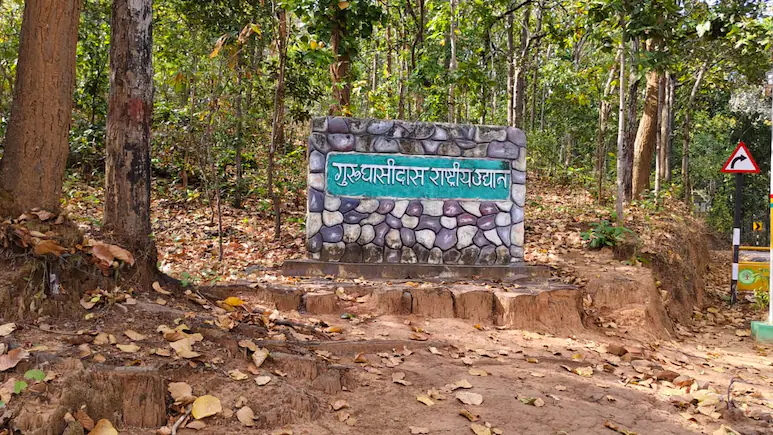
Guru Ghasidas National Park, Chhattisgarh: Official Facts, Biodiversity & Travel Guide
Introduction
Nestled on the Chota Nagpur plateau and extending into the Baghelkhand plateau, Guru Ghasidas National Park serves as the core of the newly notified Guru Ghasidas–Tamor Pingla Tiger Reserve in northern Chhattisgarh. Officially declared India's 56th tiger reserve on November 18, 2024, by the Government of Chhattisgarh with approval from the National Tiger Conservation Authority (NTCA), this expansive landscape covers 2,829.38 sq km, including a core/critical tiger habitat of 2,049.2 sq km (encompassing Guru Ghasidas National Park and Tamor Pingla Wildlife Sanctuary) and a 780.15 sq km buffer zone.
Featuring varied terrain with dense forests, perennial streams, rivers, and waterfalls, the reserve plays a pivotal role in regional tiger conservation by connecting to Sanjay Dubri Tiger Reserve (Madhya Pradesh), Bandhavgarh Tiger Reserve (Madhya Pradesh), and Palamau Tiger Reserve (Jharkhand), forming a vast ~4,500 sq km conservation complex
What and Where is Guru Ghasidas National Park?
Guru Ghasidas National Park lies within the Guru Ghasidas–Tamor Pingla Tiger Reserve, covering Manendragarh–Chirmiri–Bharatpur, Korea, Surajpur, and Balrampur districts in northern Chhattisgarh. Geographically, it spans the Chota Nagpur and Baghelkhand plateaus, with boundaries from Anandpur (north) to Mendra (south) and Jogia (east) to Sukhtarato Garnai-Chandha (west). The landscape features rolling hills (e.g., Khekhra Koda), rivers (Gopad, Hasdo, Banas, Pairi, Bijadhur, Bania), and dense forests, creating ideal habitats for tigers, leopards, and prey species like chital. Its proximity to Sanjay Dubri Tiger Reserve (Madhya Pradesh) ensures a seamless conservation corridor.
Quick facts
Status: India's 56th Tiger Reserve (Guru Ghasidas–Tamor Pingla), Announced on November 18, 2024; NTCA granted final approval in October 2021 and the state notified the reserve on NTCA’s advice
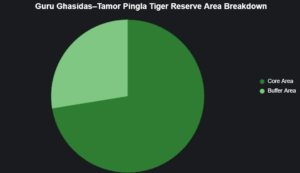
Total area (Tiger Reserve): 2,829.38 sq km; Core: 2,049.2 sq km; Buffer: 780.15 sq km (official NTCA and PIB data).
Biogeography: Chota Nagpur and Baghelkhand plateaus, with rolling hills, dense forests, rivers (e.g., Gopad, Hasdo, Banas), and waterfalls.
Biodiversity: 753 documented species, including 365 invertebrates (mostly insects) and 388 vertebrates, with 230 bird species and 55 mammal species.
Rank by size: Third-largest tiger reserve in India, after Nagarjunasagar-Srisailam (Andhra Pradesh) and Manas (Assam).
State context: Chhattisgarh's fourth tiger reserve, joining Achanakmar, Indravati, and Udanti–Sitanadi, bolstering Project Tiger initiatives
Location and landscape
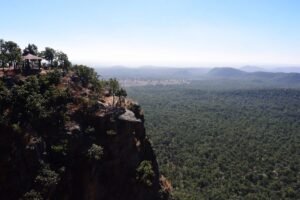
Guru Ghasidas National Park is embedded within the Guru Ghasidas–Tamor Pingla Tiger Reserve, spanning the districts of Manendragarh–Chirmiri–Bharatpur, Korea, Surajpur, and Balrampur in Chhattisgarh. The landscape features a mosaic of plateaus, hills (e.g., Baland Garhi, Bhada Hills, Khekhra Koda), and river systems like Gopad, Hasdo, Banas, Pairi, Bijadhur, and Bania, supporting diverse habitats ideal for tigers, co-predators, and prey. Its geographical boundaries stretch from Anandpur in the north to Mendra in the south, and Jogia in the east to Sukhtarato Garnai-Chandha in the west. The reserve's contiguity with Sanjay Dubri Tiger Reserve creates a seamless conservation corridor, enhancing genetic diversity for wide-ranging species.
Legal status and area
Notified under the Wildlife (Protection) Act, 1972, the Guru Ghasidas–Tamor Pingla Tiger Reserve integrates Guru Ghasidas National Park (1,440.70 sq km forest area) and Tamor Pingla Wildlife Sanctuary as its core, with NTCA oversight for Project Tiger. Official figures confirm a total area of 2,829.38 sq km, divided into 2,049.2 sq km core and 780.15 sq km buffer, providing robust protection against habitat fragmentation. This status ensures technical and financial support from NTCA, aligning with India's National Wildlife Action Plan.
Biodiversity

image credit-Korea.gov.in
Documented with 753 species, the reserve's biodiversity includes 365 invertebrates (predominantly from the class Insecta) and 388 vertebrates. Among vertebrates, 230 bird species.
Mammals: Tigers, leopards, elephants, sloth bears, chinkara, wolves, otters, chital, sambar, and monkeys.
Birds: Hornbills, kingfishers, peacocks, eagles, kites, hoopoes, mynas, herons, and forest cocks.
Flora: Dominant trees like sal, haldu, tendu, char, sidha, amla, kusum, sajja, jamun, and banyan, plus medicinal plants (Tejraj, Bhojraj, Harra, Bahera). The mosaic of forests, streams, and plateaus supports threatened species, making the reserve a biodiversity hotspot
Connectivity and conservation significance
Embracing a landscape-level conservation strategy per India's National Wildlife Action Plan, the reserve is directly contiguous with Sanjay Dubri Tiger Reserve (Madhya Pradesh) to the north, forming a 4,500 sq km complex. It further connects westward to Bandhavgarh Tiger Reserve (Madhya Pradesh) and eastward to Palamau Tiger Reserve (Jharkhand), facilitating gene flow, population viability, and movement of tigers and other species. This network strengthens Chhattisgarh's tiger conservation framework and supports long-term species recovery under Project Tiger.
Things to Do in Guru Ghasidas–Tamor Pingla Tiger Reserve
Wildlife Safaris: Jeep safaris offer chances to spot tigers, leopards, and birdlife; book via Chhattisgarh Forest Department portals.
Birdwatching: Ideal for spotting 230 bird species, especially hornbills and kingfishers, with guided tours in winter.
Nature Treks: Explore trails around waterfalls and rivers like Hasdo or Gopad, guided by forest officials.
Eco-Tourism: Engage with local communities and learn about conservation efforts in buffer zones.
Note: Always check NTCA or state forest department guidelines for permitted activities and zones
How to reach
By air: Nearest airport is Darima (Ambikapur), ~93 km from Baikunthpur (district HQ); Raipur Airport is ~333 km away.
By train: Baikunthpur Road Railway Station is ~23 km from the park vicinity near Sonhat block.
By road: ~35 km from Baikunthpur and ~5 km from Sonhat, with good connectivity via national highways from Raipur (~330 km)
Visitor notes (official)
The reserve features dense sal and mixed forests, hills, rivers, and waterfalls in the Korea district, ideal for wildlife safaris and ecotourism. Check official NTCA, Chhattisgarh Forest Department, or district portals for entry permits, safari zones, seasonal restrictions, and safety guidelines. Best visited October to June; monsoons may limit access.
FAQS
Where is Guru Ghasidas National Park?
In northern Chhattisgarh, spanning Manendragarh–Chirmiri–Bharatpur, Korea, Surajpur, and Balrampur districts across Chota Nagpur and Baghelkhand plateaus.
Is Guru Ghasidas a tiger reserve?
Yes, it forms the core of the Guru Ghasidas–Tamor Pingla Tiger Reserve, notified as India’s 56th tiger reserve on November 18, 2024.
What is the total area and zoning?
Total: 2,829.38 sq km; Core: 2,049.2 sq km; Buffer: 780.15 sq km.
How rich is the biodiversity?
753 species, including 230 birds, 55 mammals, and diverse flora like sal and medicinal plants.
How is it connected to other reserves?
Ans-Contiguous with Sanjay Dubri (MP); linked to Bandhavgarh (MP) and Palamau (Jharkhand), forming a ~4,500 sq km complex.
Conclusion
The Guru Ghasidas–Tamor Pingla Tiger Reserve, with Guru Ghasidas National Park at its heart, is a flagship for central India’s conservation efforts, blending robust legal protection with a vast, biodiverse landscape. Its 753 species, extensive core habitat, and strategic connectivity to Sanjay Dubri, Bandhavgarh, and Palamau make it pivotal for India’s Project Tiger goals, ensuring sustainable tiger and wildlife populations.
References
Continue the adventure with in-depth park guides—from habitats and flagship species to permits, access, and stay options. Tap the links below to explore top destinations across India’s wilderness.
Jaldapara National Park And Wildlife Sanctuary
Hemis National Park : The Largest National Park In India
Gir National Park: Glorious History & Exciting Tourism (2025)
Kaziranga National Park | Explore Assam’s Incredible Wildlife | 2025
Sanjay Gandhi National Park – History, Overview & Highlights
National Parks in India, 2025 – Complete List of 107 Beautiful Parks